0
The problem: hard constraints, every step, every start
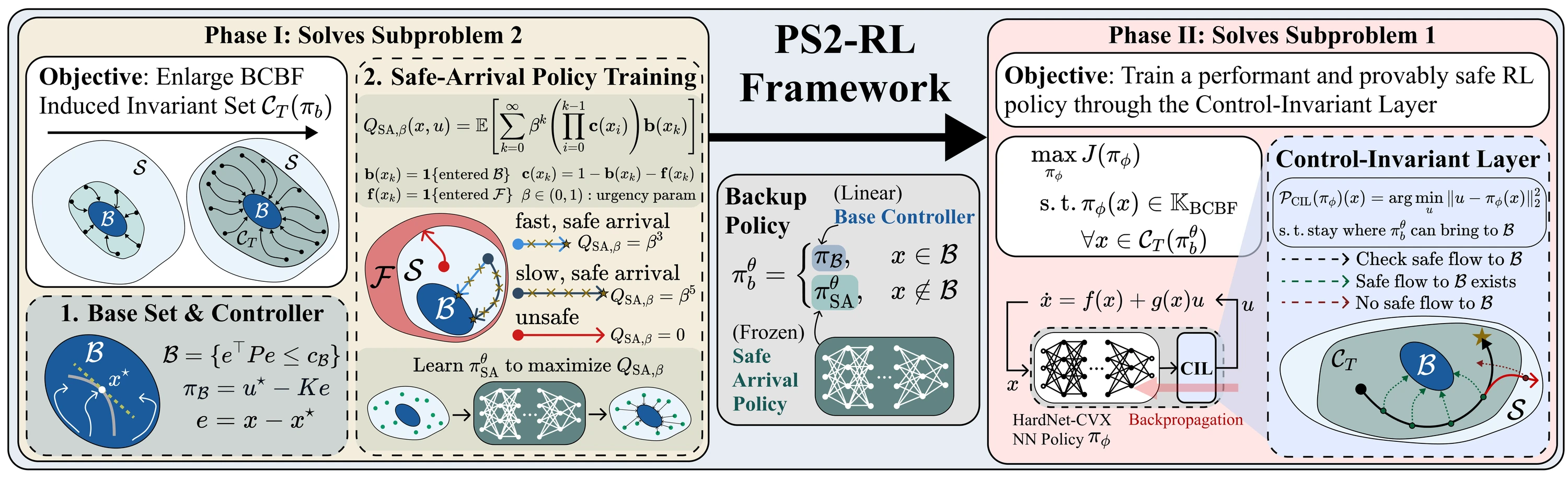
We want the reward-maximizing policy among those that are provably safe under bounded inputs:
$$\max_{\pi}\; J(\pi)=\mathbb E\Big[\sum_{k=0}^{\infty}\gamma^k r(x_k,u_k)\Big]\quad\text{s.t.}\quad x_k\in\mathcal S,\;\; u_k\in\mathcal U\quad \forall k\ge 0,\;\forall x_0\in\mathcal X_0.$$
Penalty and Lagrangian (CMDP) methods only encourage this, so failures can still happen at deployment. Provable methods need a control-invariant set, a region from which safety can be maintained forever. Computing one explicitly is the bottleneck: Hamilton–Jacobi reachability grows exponentially with state dimension, and sum-of-squares certificates tend to be conservative.